
PLDD in Thailand: Could a Minimally Invasive Approach Help Your Herniated Disc Pain?
Persistent back pain can gradually make life smaller.
Long flights become difficult. Sitting through a meeting feels exhausting. Exercise, travel and even sleep may be affected. For some people, the pain extends from the lower back into the buttock or leg, sometimes accompanied by tingling, numbness or weakness.
When medication, activity modification or physiotherapy has not provided sufficient relief, the next question is often:
“Do I need major spine surgery, or is there another option worth discussing?”
For selected patients with lumbar disc herniation, Percutaneous Laser Disc Decompression, commonly known as PLDD, may be one minimally invasive option to consider.
PLDD is not suitable for every type of back pain or every herniated disc. The most important step is not choosing the procedure—it is determining the true source of the pain and whether the patient’s symptoms, examination and imaging findings match.
What Is PLDD?
PLDD stands for Percutaneous Laser Disc Decompression.
During the procedure, a physician places a fine needle into the affected intervertebral disc under imaging guidance. A laser fibre is introduced through the needle and controlled laser energy is used to remove a small amount of material from the centre of the disc.
The aim is to reduce pressure within the disc. In appropriately selected cases, this may reduce irritation or pressure affecting a nearby nerve root.
Unlike open spine surgery, PLDD does not require a large incision or extensive removal of surrounding tissue. However, it is still a medical procedure with potential risks, limitations, and the possibility that further treatment may be required.
What Type of Pain May Be Related to a Herniated Disc?
A lumbar disc herniation may irritate or compress a nerve leaving the spine. Symptoms can include:
- Lower-back pain
- Pain radiating into one leg
- Tingling or numbness
- Pain that becomes worse while sitting
- Difficulty walking or remaining in one position
- Weakness affecting part of the leg or foot
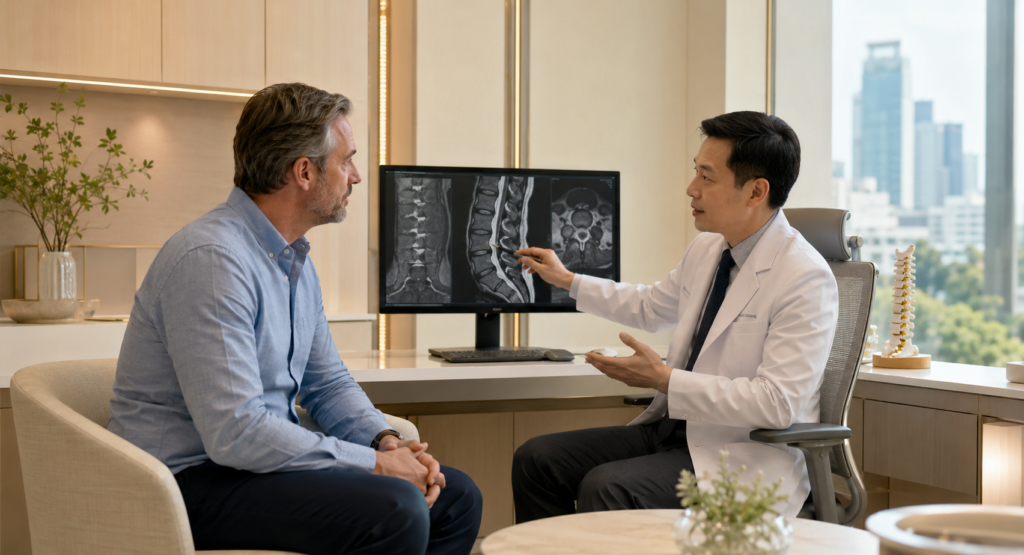
These symptoms can also be caused by other conditions. An MRI finding alone does not prove that a particular disc is responsible for the pain. The imaging must be interpreted together with the patient’s symptoms and physical examination.
Who May Be Considered for PLDD?
A specialist may consider PLDD when a patient has:
- Symptoms consistent with a lumbar disc problem
- A contained disc protrusion or herniation that may respond to decompression
- Imaging findings that correspond with the location of the symptoms
- Persistent symptoms despite appropriate conservative care
- No emergency neurological warning signs
- A clinical profile in which the expected benefits reasonably outweigh the risks
These are general considerations, not eligibility criteria. Final suitability can only be determined by a qualified physician after reviewing the individual case.
Why PLDD Is Not Suitable for Everyone
PLDD is designed for a relatively specific clinical situation. It may not be appropriate when pain is caused primarily by severe spinal stenosis, spinal instability, fracture, infection, tumour, or another condition unrelated to disc pressure.
Certain types of large, extruded or separated disc fragments may also require a different treatment approach.
Most importantly, PLDD should not be presented as a guaranteed alternative to surgery. Some patients may experience limited improvement or may later require another procedure or conventional surgery.
Current clinical evidence is mixed. Research suggests that selected patients may achieve meaningful improvement, but patient selection is critical and more high-quality evidence is still needed.
What Should International Patients Prepare Before Travelling?
Before travelling from Singapore, Vietnam, Australia or Indonesia, patients should ideally prepare:
- A recent MRI scan and radiology report, if available
- A summary of symptoms and when they began
- Details of previous medication, physiotherapy, injections or procedures
- Relevant medical conditions, allergies and current medication
- Questions about expected recovery, follow-up and fitness to fly
Medical records may be reviewed before travel to determine whether an in-person specialist consultation would be appropriate. This preliminary review does not replace diagnosis or physical examination.
Patients should not book non-refundable travel based only on an online description of PLDD.
When You Should Seek Urgent Care Locally
Do not delay urgent medical assessment in order to travel if back or sciatic pain is accompanied by:
- New difficulty controlling the bladder or bowel
- Numbness around the genitals, anus, or buttocks
- Rapidly worsening weakness or sensation changes in both legs
- Sudden severe bilateral leg symptoms
- Other rapidly progressing neurological symptoms
These can be warning signs of a serious condition requiring immediate assessment at a local emergency department.
Planning a Pain-Management Journey in Thailand
For international patients, treatment involves more than the procedure itself. A well-planned journey should address:
- Specialist assessment and imaging review
- Clear explanation of all reasonable treatment options
- Transparent quotation from the medical provider
- Appropriate time for observation and recovery
- Accommodation and local transportation
- Medical guidance on when it is safe to fly
- A follow-up plan after returning home
The length of stay and recovery timeline should be determined individually by the treating physician. Patients should avoid assuming that they can fly immediately after treatment.
How The Well Siam Supports International Patients
The Well Siam is a medical and wellness concierge—not a hospital and not the treating medical provider.
We help international patients navigate selected pain-management services in Thailand by coordinating:
- Preliminary medical-record collection
- Appointments with licensed clinical partners
- Treatment quotations and scheduling
- Airport transfer and local transportation
- Accommodation arrangements
- Language and coordination support
- Post-treatment communication and follow-up planning
Medical decisions remain between the patient and the treating physician. Medical fees are paid directly to the clinical provider, without a treatment-fee mark-up from The Well Siam.
The Right Question Comes Before the Right Procedure
PLDD may be worth discussing for certain cases of lumbar disc herniation, particularly when symptoms continue despite conservative treatment and the patient is seeking a less invasive approach.
But the most responsible starting point is not:
“Can I have PLDD?”
It is:
“What is causing my pain, and which evidence-informed options are appropriate for my specific condition?”
If you are considering pain-management treatment in Thailand, The Well Siam can help organise an initial case review and connect you with an appropriate clinical team.
Speak with The Well Siam concierge team to begin a confidential preliminary enquiry.
Medical disclaimer: This content is provided for general educational purposes and does not constitute medical advice, diagnosis or a treatment recommendation. Treatment suitability, risks, recovery and outcomes vary by individual. Consultation with a licensed medical professional is required.
Medical References
- NICE. Percutaneous intradiscal laser ablation in the lumbar spine.
- Brouwer PA, et al. Percutaneous laser disc decompression versus conventional microdiscectomy in sciatica: a randomised controlled trial.
- Cambridge University Hospitals NHS Foundation Trust. Back pain and cauda equina syndrome patient guidance.